Trusted Building Inspection in Melbourne

Best Pre buy home inspection Melbourne
October 7, 2026
Purchasing real estate across Greater Melbourne and regional Victoria represents one of the most significant financial investments you will ever make. Whether you are acquiring a heritage Victorian weatherboard in the inner suburbs, a contemporary apartment in the CBD, or a modern family home in the outer growth corridors, unseen physical defects can jeopardize your equity and personal safety. Engaging a certified, independent Melbourne building inspector ensures that behind every styled interior and fresh coat of paint lies a sound, compliant, and durable structure. Navigating property acquisitions without professional oversight exposes buyers to post-settlement financial stress. Standard home insurance policies routinely exclude damages resulting from pre-existing structural issues, ground movement, or active timber-destroying pests. A comprehensive evaluation conducted under Australian Standards provides complete physical transparency, allowing you to sign contracts with confidence, negotiate fair repair terms, or safely exit high-risk agreements.
The Role of Australian Standards in Property Inspections
A professional building audit must adhere to rigorous national protocols to ensure accuracy, objectivity, and legal validity. When evaluating services across Victoria, confirm that your assessor operates in full compliance with two core Australian Standards:
-
AS 4349.1 (Residential Building Inspections): Sets the strict baseline methodology for visual, non-invasive examinations of accessible internal and external zones, identifying major structural defects, minor maintenance issues, and immediate safety hazards.
-
AS 4349.3 (Timber Pest Inspections): Governs specialized evaluations for subterranean termites, wood-boring beetles, and fungal decay, determining active infestations, past structural damage, and environmental factors that attract pests.
By enforcing compliance with AS 4349.1 and AS 4349.3, independent property auditors provide standardized reporting complete with high-definition digital imagery and diagnostic data.
Why a Pre Purchase Building Inspection is Critical in Victoria
Entering an unconditional real estate contract without a detailed Pre purchase building inspection leaves buyers vulnerable to costly structural surprises. Sellers and real estate agents present properties in their best visual condition, often masking underlying maintenance deficits.
An independent building audit bridges the gap between surface appearance and true structural integrity. Conducting a thorough pre-purchase evaluation provides distinct strategic advantages:
-
Uncovering Hidden Liabilities: Identifies costly structural issues such as sagging roof framing, failing waterproofing membranes, subsiding footings, and degraded subfloor stumps before settlement.
-
Contractual Protection: Standard Victorian land sale contracts frequently include “subject to building and pest inspection” clauses. An adverse professional report provides the legal evidence needed to exit a contract without losing your deposit.
-
Powerful Negotiation Leverage: Documented structural defects backed by photographic evidence allow buyers to request price adjustments or demand that vendors rectify significant hazards prior to settlement.
-
Long-Term Budgeting: Minor defects and environmental risk factors noted in the report serve as a practical maintenance roadmap for ongoing property preservation.
Core Components Evaluated During a Building and Pest Inspection Melbourne
A complete building and pest inspection melbourne service evaluates six major structural and environmental zones across the property. Each area requires detailed visual examination and diagnostic testing:
1. Internal Living Spaces and Joinery
Inspectors evaluate plasterboard walls, cornices, ceilings, timber architraves, window reveals, and floor finishes. Stepped cracking along plasterboard joints or binding doors often indicates foundation settlement or compromised floor bearers.
2. Wet Areas and Plumbing Systems
Bathrooms, ensuites, laundries, and kitchens represent primary zones for water leaks and structural decay. Auditors utilize pinless electronic moisture meters and thermal imaging cameras behind tiled surfaces to detect leaking shower trays, hidden wall-cavity moisture, and failing waterproofing seals.
3. Roof Cavities and Attic Framing
Entering the roof space allows the auditor to inspect load-bearing rafters, ceiling joists, purlins, and collar ties. The inspector verifies that roof trusses remain structurally sound, checks for missing ceiling insulation, and identifies historical roof leaks that soften timber framing.
4. Exterior Building Envelope and Cladding
The exterior envelope assessment examines brick veneer masonry, weatherboards, mortar joints, lintels, and flashings. Auditors check for cracked brickwork, degraded paint systems, rising damp, and unapproved external structures built without local council permits.
5. Roof Exterior, Flashings, and Stormwater Drainage
Using ladders or high-reach aerial inspection equipment, assessors check roof tiles, metal sheet roof panels, ridge capping mortar, and valley irons. Broken roof tiles, rusted gutters, and detached downpipes discharge rainwater directly against building foundations, causing soil erosion and subfloor dampness.
6. Subfloor Crawlspaces and Foundations
For homes on suspended timber floors, navigating the subfloor crawlspace is mandatory. The inspector checks timber or concrete stumps, bearers, joists, galvanized ant caps, cross-flow ventilation louvers, and ground moisture levels.
Integrated Timber Pest Assessments: Protection Against Biological Attacks
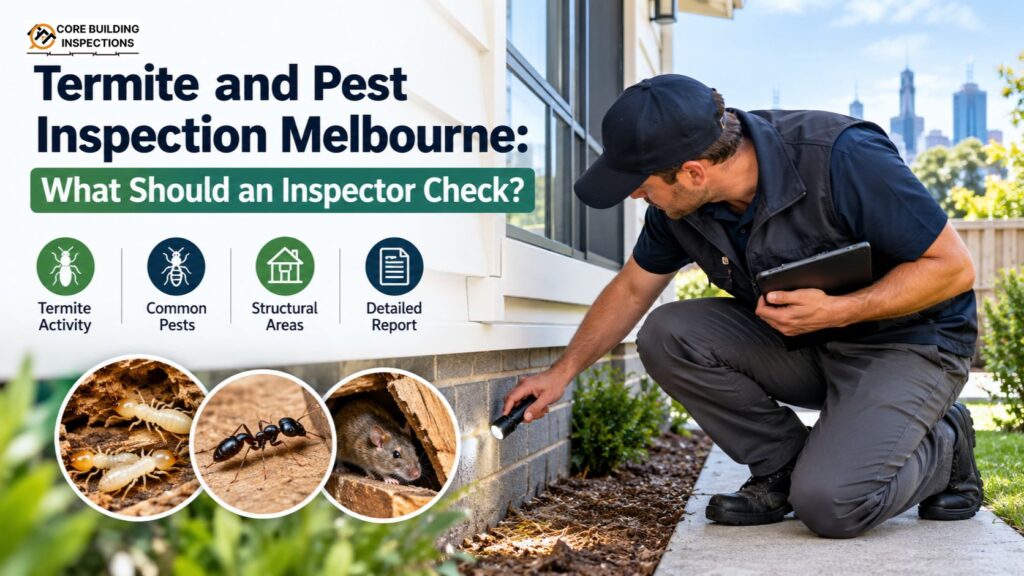
A physical building check covers structural elements, but a combined assessment incorporates a targeted termite and pest inspection in victoria. Subterranean termites (Coptotermes frenchi and Schedorhinotermes) are widespread across Melbourne, establishing subterranean galleries to feast on cellulose framing inside wall cavities and roof voids. The timber pest diagnostic process follows a methodical, three-stage evaluation to identify subterranean threats without causing structural damage. It begins with identifying visual mud leads, where the auditor inspects building footings and subfloor stumps for visible mud tracking tubes. Next, the inspector performs acoustic sounding by systematically tapping interior timber joinery, skirtings, and frames to listen for the hollow acoustic resonance characteristic of internal termite feeding. Finally, high-resolution thermal imaging is deployed to scan wall cavities and ceilings, pinpointing subtle surface temperature differentials created by the hidden thermal heat mass of active pest colonies. A dedicated timber pest audit identifies:
-
Active Termite Activity: Detecting mud tracking leads, moisture packing, and active worker termites inside structural timbers.
-
Previous Termite Damage: Identifying historical pest activity and assessing whether damaged timbers retain their structural load-bearing capacity.
-
Wood-Boring Beetles: Locating exit holes and powdery frass caused by Anobiid or Lyctid borers in subfloor floorboards and joinery.
-
Fungal Decay (Wood Rot): Pinpointing areas where high moisture levels have softened timber framing, creating ideal conditions for pest colonization.
Local Environmental Hazards Across Melbourne Regions
Melbourne’s diverse geography presents distinct environmental challenges that directly impact building longevity. A skilled local inspector tailors their evaluation based on regional soil and climate conditions:
-
Western & Northern Suburbs (Reactive Clay Soil): Suburbs like Tarneit, Point Cook, Craigieburn, and Wollert rest on highly reactive volcanic clay soils. These soils swell significantly during wet winter periods and shrink during dry summers, exerting hydraulic pressure that leads to foundation movement, slab settlement, and exterior brickwork cracking.
-
Inner-City & Eastern Suburbs (Established Timber Homes): Dwellings in Fitzroy, Richmond, Hawthorn, and Camberwell frequently feature heritage weatherboard construction over suspended timber floor systems. Poor subfloor ventilation grilles trap ground moisture, accelerating timber decay and inviting subterranean termite colonies.
-
Bayside & Coastal Suburbs (Salt-Spray Environments): Properties in St Kilda, Brighton, Frankston, and the Mornington Peninsula experience constant marine exposure. Airborne salt accelerates the corrosion of metal roof screws, valley flashings, wall lintels, and structural steelwork.
Checklist: Key Criteria for Selecting the Best Building Inspections in Melbourne
Selecting an auditor requires careful credential verification. To secure the Best Building Inspections in Melbourne, confirm that your chosen service meets the following benchmarks:
-
VBA Practitioner Registration: Ensure the inspector is registered with the Victorian Building Authority (VBA) as a building practitioner, surveyor, or engineer.
-
Comprehensive Insurance Coverage: Confirm the auditor holds current Professional Indemnity and Public Liability insurance to protect you financially.
-
AS 4349 Compliance: Verify that all reporting strictly aligns with Australian Standards AS 4349.1 and AS 4349.3.
-
Advanced Technology Integration: Ensure the inspector utilizes non-destructive tools, including high-resolution thermal imaging cameras, electronic moisture meters, and acoustic sounding equipment.
-
Fast Report Delivery: Confirm you will receive a comprehensive digital report within 24 hours of site access—a crucial factor when working within tight auction or cooling-off timelines.
-
Post-Inspection Support: Choose a service that includes direct phone consultations with the attending auditor to discuss findings in plain English.
Frequently Asked Questions
Q: How long does a full building and pest inspection take on site?
A thorough on-site evaluation for a standard three-to-four-bedroom home typically takes between 1.5 and 2.5 hours, depending on property size, age, access restrictions, and subfloor conditions.
Q: Can an inspector detect termites hidden behind bathroom tiles?
Yes. While inspectors conduct non-invasive visual audits under standard guidelines, high-resolution thermal imaging cameras and deep-probe electronic moisture meters allow auditors to identify thermal anomalies and moisture reservoirs associated with subterranean pest activity behind walls.
Q: What happens if key areas like the roof space or subfloor are inaccessible?
Under AS 4349.1, any area restricted by locked doors, low clearance, or stored items must be documented in the report under “Access Limitations” alongside clear recommendations for further investigation if hidden defects are suspected.
Q: Is a general builder’s quote sufficient instead of a formal inspection report?
No. A general builder provides repair quotes, whereas a certified property auditor conducts an independent diagnostic evaluation under Australian Standards, delivering documented legal evidence recognized by solicitors and financial institutions.
Partnering with Certified Inspection Professionals
Navigating the Victorian real estate market demands objective, technical clarity before committing your financial resources. Relying on quick visual walk-throughs or vendor-supplied marketing materials carries significant risk. For thorough, independent property evaluations across Greater Melbourne and regional Victoria, Core Building Inspections provides complete peace of mind. Their team of VBA-registered, fully insured building inspectors delivers comprehensive digital reports complete with high-resolution photographic evidence and thermal imaging within 24 hours. By providing plain-English defect breakdowns and post-inspection phone consultations, Core Building Inspections ensures you enter every property transaction with absolute clarity and negotiation confidence.